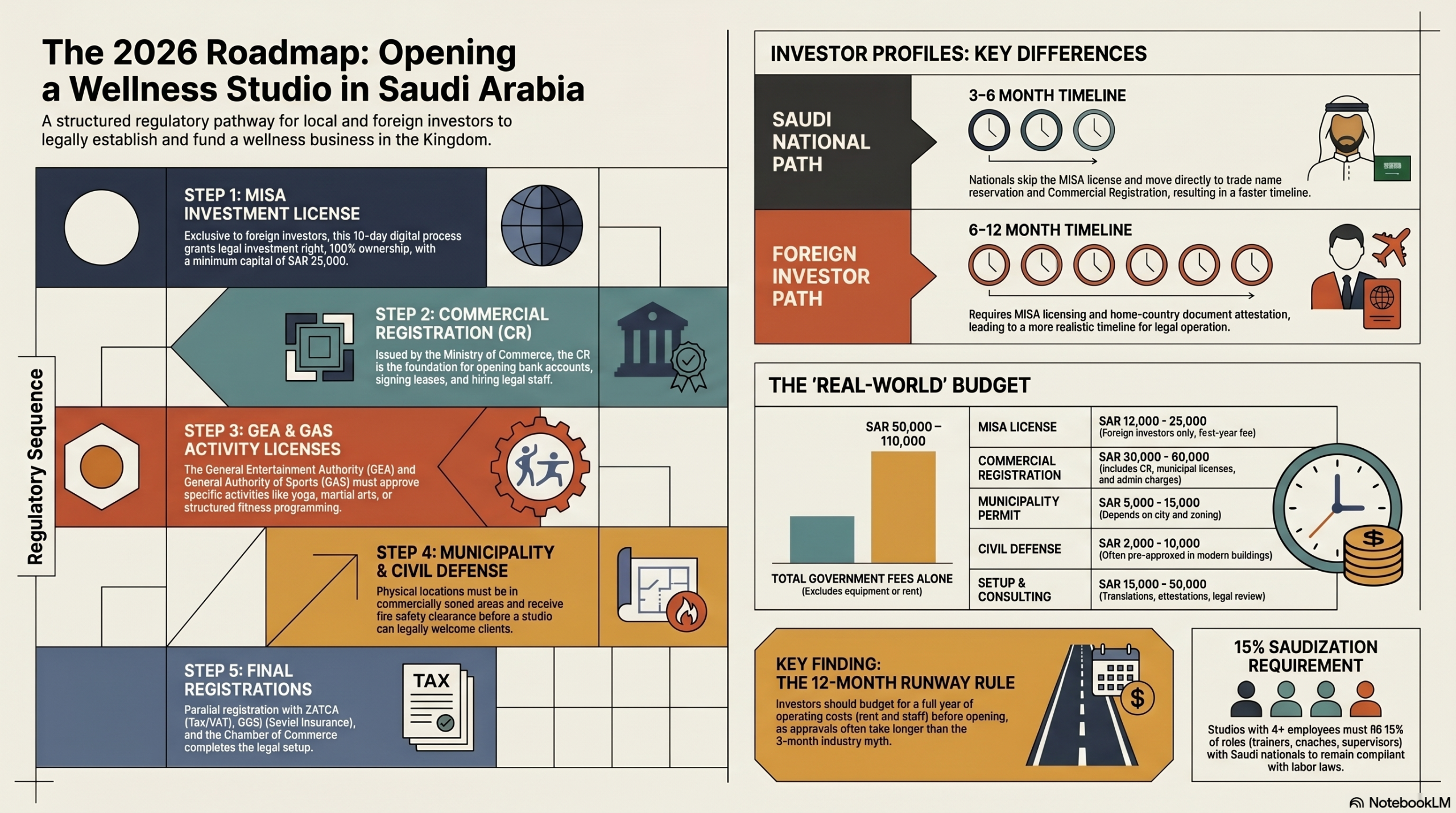
TLDR: Opening a wellness studio in Saudi Arabia requires 5+ government approvals, 6–12 months, and roughly SAR 50K–110K in government fees before you open. Here is the complete roadmap — jump to any section:
License Order · Saudi vs Foreign · Timeline · Costs · Saudization · Mistakes to Avoid · Govt Bodies
When I tell people outside the Kingdom what it takes to legally open a wellness studio in Saudi Arabia, their first reaction is: that many steps?
Yes. But none of them are optional.
Most first-time applicants underestimate the timeline by six months. They show up with a business plan and a lease and discover they need approvals from five different government bodies before a single client can walk through their door.
This guide is what I wish someone had handed me.
It covers every license you need, the exact order to get them, the difference between what a Saudi national needs versus a foreign investor, and the real costs you should budget for before you sign your first lease.
The Exact Order to Get Your Licenses
Most people make the mistake of getting excited about their space before understanding the regulatory sequence. Here is the order that actually works:
First: MISA License (foreign investors only)
If you are a foreign investor you need a Ministry of Investment license before anything else. This gives you the legal right to invest in Saudi Arabia. Without it, you cannot proceed.
The MISA license for service-sector businesses like wellness studios has good news for foreign investors. You do not need a Saudi partner. 100% foreign ownership is permitted for service activities. The minimum capital requirement for a service license is SAR 25,000 (approximately US$6,700).
Apply through the MISA e-Services Portal on Invest Saudi. The process is fully digital. With the right documents prepared, approvals can come in as fast as five to ten business days for straightforward applications.
The MISA Terms and Conditions (2024) spell out the exact requirements including the documents you need to attest from your home country before applying.
Second: Commercial Registration (everyone)
Once you have your MISA license (or if you are a Saudi national, you skip that step), you register your company with the Ministry of Commerce.
This step authorizes your business as a legal entity. You will need a reserved trade name, your Articles of Association, proof of your physical address, and your MISA license if you are foreign.
Your trade name must be unique and comply with Saudi naming rules. The Ministry of Commerce platform handles name reservation and the CR application.
Note from 2025 regulations: Commercial Registrations no longer expire, but you must complete annual electronic confirmation that your information is current. This replaced the old renewal system and gives businesses more flexibility.
Third: GEA Activity License
With your CR in hand you apply to the General Entertainment Authority for your specific activity license. This is where you declare what your studio actually does: fitness classes, spa services, martial arts, yoga, or a combination.
The GEA application is submitted through their online portal. You will need to provide your CR, your location details, and documentation of the activities you plan to offer.
GEA also reviews your proposed activities against cultural compliance standards. This is not complicated for standard wellness businesses but it is mandatory. All activities must conform to Saudi Arabian values and social traditions.
Fourth: Municipality Location Permit
Your physical space needs municipal approval. The location must be in a commercially zoned area. Residential buildings or spaces in non-approved zones will be rejected regardless of how perfect they are for your concept.
You will need your lease agreement, floor plans, and details about the nature of your business. The municipality will check that the space meets requirements for occupancy, accessibility, and appropriate zoning.
Fifth: Civil Defense Clearance
Fire safety approval from Civil Defense is required before you can open. This covers emergency exits, fire extinguishers, smoke detectors, and overall building safety standards.
Ideally, negotiate this into your lease negotiations. Many commercial buildings in Saudi Arabia already have Civil Defense pre-approval. Ask your landlord before signing.
Sixth: Additional Registrations
Once your activity license is approved you register for:
- ZATCA — for VAT compliance and Zakat obligations
- GOSI — General Organization for Social Insurance for any employees you hire
- Chamber of Commerce — mandatory membership for most commercial entities
These can run in parallel with some of the above steps.
Saudi National vs Foreign Investor: The Key Differences
The process is similar but there are meaningful differences.
For Saudi Nationals
You do not need a MISA license. You go straight to the Ministry of Commerce for your Commercial Registration.
Your process is: reserve trade name, draft and notarize Articles of Association, apply for Commercial Registration, apply for GEA activity license, municipality permit, Civil Defense clearance, then ZATCA, GOSI, and Chamber of Commerce registrations.
For Foreign Investors
You need the MISA investment license first. This adds a step but 100% foreign ownership means you do not need a local partner or sponsor for the business itself.
Your process is: obtain MISA investment license, reserve trade name, apply for Commercial Registration, apply for GEA activity license, municipality permit, Civil Defense clearance, then ZATCA, GOSI, and Chamber of Commerce registrations.
The key advantage for foreign investors in 2026: the old requirement for a Saudi sponsor or partner has been removed for most service-sector businesses including wellness studios. You can own 100% of your company. Full details are in the MISA Investor Guide.
The catch: some administrative steps may move faster if you have a local consultant or liaison who understands the system. Many foreign investors use a setup company for this reason. Budget for that cost.
The Real Timeline: Do Not Trust the Optimistic Estimates
Here is what the actual timeline looks like:
For a Saudi national with documents ready and no complications: three to six months from first application to legal operation.
For a foreign investor: six to twelve months minimum. MISA processing alone can take weeks to months depending on document completeness and application complexity. Embassy attestation of documents in your home country can add four to eight weeks if not planned for.
Here is the part most people miss: every step after your MISA license and CR adds waiting time. GEA processing, municipality review, Civil Defense inspection. None of these happen instantly.
The practical advice: do not sign your lease and expect to open within three months. You should be paying rent on your space for at least six months before you expect to be legally operational. Budget for this.
The Real Costs You Need to Budget
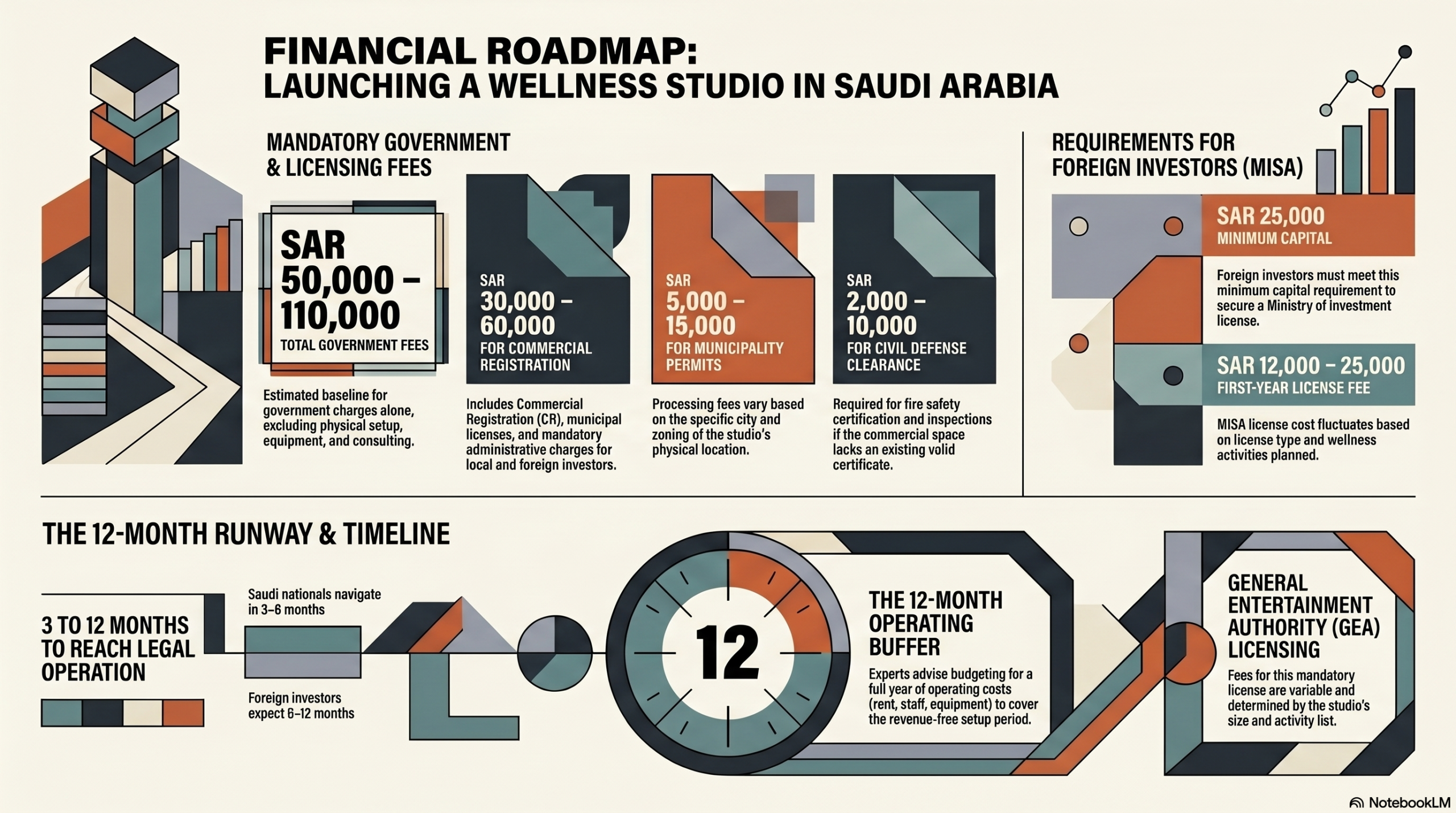
These are the government fees you can anticipate. Setup and consulting costs are separate.
MISA Investment License (foreign investors)
Government fees: SAR 12,000 to 25,000 for the first year depending on license type and activity, according to MISA’s published fee structure.
Commercial Registration
Total registration fees including CR, municipal licenses, and admin charges: approximately SAR 30,000 to 60,000 (approximately US$8,000 to $16,000) according to the AstroLabs Saudi business setup guide. This is a range because costs vary by company type and registration complexity.
GEA Activity License
GEA fees vary by activity type and studio size. Contact GEA directly through their portal or through a setup consultant for your specific activity fee. The license fee is separate from the CR fees above.
Municipality Permit
Location-specific. Depends on your city and the zoning of your space. Budget a minimum of SAR 5,000 to 15,000 for municipality processing and fees.
Civil Defense
Typically included in your building’s existing certifications if the property is already approved for commercial use. If your space requires a fresh inspection, budget SAR 2,000 to 10,000.
Additional Registrations
ZATCA registration is free for basic VAT registration. GOSI fees depend on your number of employees. Chamber of Commerce membership is typically modest (a few thousand SAR annually).
Setup and Consulting
This is where many first-time investors underestimate costs. Document preparation, Arabic translations, embassy attestations, liaison services, and legal review can add SAR 15,000 to 50,000 or more depending on how much you outsource.
A practical total budget for government fees alone: SAR 50,000 to 110,000 (approximately US$13,000 to $29,000) before you buy a single piece of equipment or pay rent.
Saudization Requirements You Must Plan For
As of 2026, the Ministry of Human Resources and Social Development has introduced Saudization requirements for sports and fitness businesses, as reported by Fragomen.
If your gym or sports center has four or more employees in specified roles, you must fill 15% of those positions with Saudi nationals. This applies to roles including fitness trainer, personal trainer, sports coach, and sports supervisor.
This is not optional. Employers that do not comply may face suspension of Ministry services, which affects your ability to transfer employees and renew work permits.
The practical implication: do not plan your staffing model assuming all your trainers are foreign. Factor Saudi national hiring into your operating model from the start.
What Type of Wellness Studio Are You Opening?
The licensing path varies depending on your primary activity.
Fitness gym or sports center
GEA licensing plus GAS approval from Business Saudi. You will also need the General Authority of Sports classification for your specific fitness activities. Municipal and Civil Defense requirements apply.
Spa or wellness center
Primarily GEA licensing with municipality approval. If you offer any health or medical-adjacent services (physiotherapy, medical massage), you may need additional approvals from the relevant health authority.
Yoga or meditation studio
GEA licensing for wellness activities. Usually less complex than a full gym license. Municipality permit and Civil Defense still required.
Women-only wellness studio
All of the above plus specific compliance with gender-segregation standards. The physical space requirements for women-only facilities must be clearly planned from the lease stage. Many commercial buildings in Saudi Arabia now have designated spaces approved for gender-separated use.
What Most First-Time Applicants Get Wrong
They sign a lease before understanding licensing.
Your lease should be conditional on you obtaining the necessary licenses for your intended activity at that location. Many landlords will agree to this. If they will not, that is a red flag.
They underestimate document attestation time.
If you are a foreign investor, documents from your home country (certificate of incorporation, Articles of Association, financials) must be attested by the Saudi Embassy in your country. This can take six to eight weeks if your home country’s embassy has processing delays. Plan for this before you start the MISA application.
They confuse GEA and GAS requirements.
Wellness studios offering structured fitness programming need both GEA and GAS approvals. Pure wellness activities like spa or meditation may only need GEA. Know which applies to your specific activity.
They skip the Saudization planning.
If you are hiring trainers and instructors you need a Saudization plan before you open. Finding qualified Saudi nationals for fitness instructor roles takes time. Start recruiting early.
Once you have your licenses and your studio is operational, you will also need a scheduling system that handles gender-segregated sessions cleanly. Wellness studio software designed for GCC studios can manage multi-track scheduling automatically, so you are not juggling WhatsApp groups and spreadsheets to keep your schedule organized.
They plan for the fastest timeline instead of the realistic one.
If your documents are perfect and your location is already commercially approved, the process can move fast. But one missing document, one incomplete attestation, or one municipal issue with your space can add months. Always plan for the worst case.
How to Actually Speed This Up
Work with a local business setup consultant for your first Saudi venture. The cost is worth it. They know which municipal offices are faster, which inspectors to call first, and how to phrase your GEA application to avoid back-and-forth.
Prepare all your documents in advance. Arabic translations of everything. Embassy attestations done before you start the MISA application. A local sponsor or liaison who can follow up in person when government offices need clarification.
Start the MISA and CR process while you are still finalizing your space search. These do not require a signed lease. You can be progressing on the company registration side while you find the right location.
The Financial Runway You Actually Need
Here is the number I want you to remember: budget for twelve months of operating costs before you open.
You will be paying rent, possibly staff costs, equipment installments, and setup fees while you wait for approvals. Most studios do not open to clients for six to twelve months from the day they submit their first application.
A conservative runway for a new wellness studio in Saudi Arabia: enough cash to cover twelve months of rent plus setup costs plus government fees, with no revenue coming in yet.
That number is uncomfortable. But studios that plan for it do not have to make desperate decisions mid-approval process. Studios that assume they will open in three months often end up in financial trouble or having to rush approvals in ways that create compliance problems later.
The Five Government Bodies That Must Approve You
Before you open a wellness studio in Saudi Arabia you need sign-offs from multiple authorities. Not all apply to every studio type, but here is the full list:
Ministry of Investment (MISA) — issues your investment license if you are a foreign investor. This is step one for anyone investing from outside Saudi Arabia. Their official portal is Invest Saudi and they publish an Investor Guide PDF covering the full process.
Ministry of Commerce — issues your Commercial Registration (CR). This is step one for Saudi nationals and mandatory for everyone. Without a CR you cannot open a bank account, sign a lease, or hire legally. Their e-services portal is at mc.gov.sa.
General Entertainment Authority (GEA) — licenses the actual wellness or fitness activity. A spa, a gym, a yoga studio, a martial arts center. Any activity that falls under entertainment or wellness falls here. The GEA portal handles the application process and their licensing covers fitness studios, entertainment centers, and wellness businesses. You can also access GEA services through the unified my.gov.sa platform.
General Authority of Sports (GAS) — separately governs sports and fitness activities specifically. Some fitness studio types need GAS approval in addition to GEA. You can check Business Saudi for the specific licensing requirements for sports centers and gyms. The distinction matters. A yoga studio might fall purely under GEA. A gym offering structured fitness programming may need GAS sign-off too.
Municipality — your specific location needs a permit. This covers zoning, building compliance, and that your physical space is approved for commercial wellness activity. Residential buildings are usually not allowed.
Civil Defense — fire safety clearance. Required for any physical studio space. You cannot skip this even if everything else is approved.
Additional registrations you will also need: ZATCA for VAT and tax, GOSI for employee social insurance, and membership in your local Chamber of Commerce.